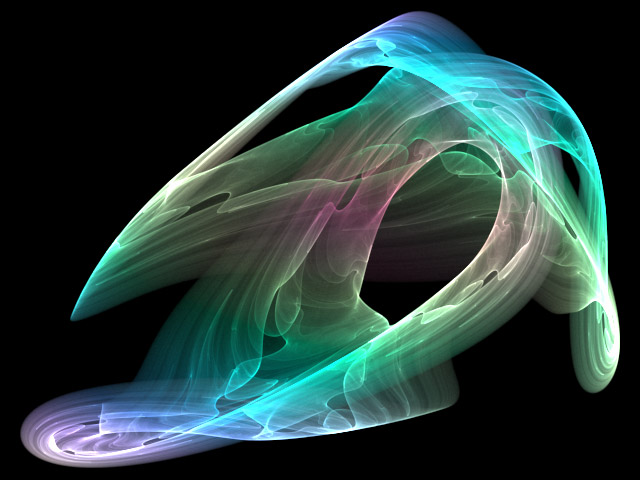
 The order is associated with a significant degree of prediction, chaos happens otherwise. Linear systems, represent the order, are predictable and comfortable to handle, hence our tendency to generalize. Faced with a myriad of situations we generalize, we plan to present data to try to find a future behavior and almost always goes well. But there are systems that resist: small variations, uncertainties in initial conditions lead to completely uncontrolled and unpredictable end. These are called chaotic systems (Figure , strange attractor "poisson_saturne" done with the program Chaoscope ).
 To study these systems requires a different methodology. Their study was done in the so-called phase space, an abstract space in which all variables represent the system dynamics. For example, an ideal simple pendulum would be represented by two variables, speed and the position of the sprung mass. His portrayal may be, therefore, in the plane and would be a circle. Each point on the same two numbers represent the speed and position, at that time.
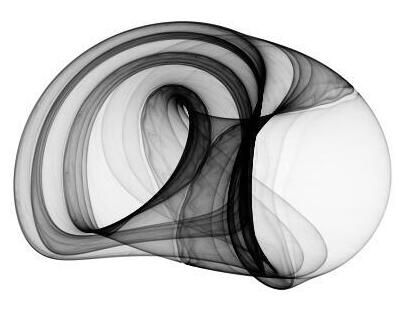
That figure in the phase space, which approximates the studied phenomenon is called the attractor. In chaotic systems the attractor is not usually a point, a circle, a geometric figure known, but in chaotic systems is shaped "strange", hence receiving the name of "strange attractor" with a fractional or fractal dimension (Figure , attractor Lorenz, 3D with the program Chaoscope ).
The first of these was found , by chance, by the meteorologist Edward Lorenz when he tried to find a mathematical model to predict the behavior of large air masses. Managed to adjust the model to only three variables that indicate how to change the speed and air temperature over time (Lorenz attractor).
After studying the model, re-enter the initial data - this time with fewer decimal places, and the result we got was completely different than before. When reflecting on the results realized the system was extremely sensitive to initial conditions: small perturbations in the initial data have a great influence on the outcome. His equations captured the essence of the real atmosphere. "That first day (Winter 1961) decided that the broad predictions were doomed to extinction." But it was more than chance in their model of time: a fine geometric structure, order disguised as accident.
To explain in a graphical way - and exaggerated - the question occurred to him that the mere flapping of a butterfly, which had not been taken into account in the initial data, a prediction could be modified to make it completely unviable after a certain time.
 About
About Butterfly Effect have written hundreds of articles, novels, songs and movies have been made. On the topic is very interesting an article Enrique Dans, professor at the Instituto de Empresa, which compares the "Internet ecosystem" with the nonlinear and complex systems like the weather: "The variables involved (in Internet) are not so: if we talk about climate mainly speed and air temperature, the Internet comes to visit, links and related matters. But the potential impact of an infinitesimal change in measurement of background variables can have a brutal impact on the final results ,...". "Criteria for everyone, apparently, taken for good, as the sacred Google PageRank, inbound links account for a website that carries out Technorati or Alexa popularity rankings are measured fully crude, rude, lacking intelligence, which respond only to desire and seek to reduce uncertainty, but they do, in general, pretty bad. "
In this sense we are in the era before the discovery of the butterfly effect, we use linear methods to try analyze complex systems, nonlinear, where the feedback of all kinds, and at all levels, are the very essence of the system. We need to know "the strange attractor of the Internet."
About: "Chaos, Making a New Science" by James Gleik. Seix Barral. Barcelona 1988. A magnificent book. ( Reissue of the post of October 17, 2006.)
Could be the very history of humanity as a very sensitive to initial conditions? :
"There's something amazing that I have always drawn attention to the story. It happened before, happens now and possibly ever will, humanity does not seem to know or can really control, where it goes. The events will happen and when all seems tied up and in place, comes a new incident that disrupts all, wars, revolutions, economic crisis or other catastrophe. In these situations the story, after they occurred, draws conclusions and helps us to prevent their recurrence, but there is always something that escapes us and everything returns to lead a new catastrophe, everything starts over again. "
Continue reading: History , dignity and butterfly effect, my collaboration with Book notes. A hug.


0 comments:
Post a Comment